

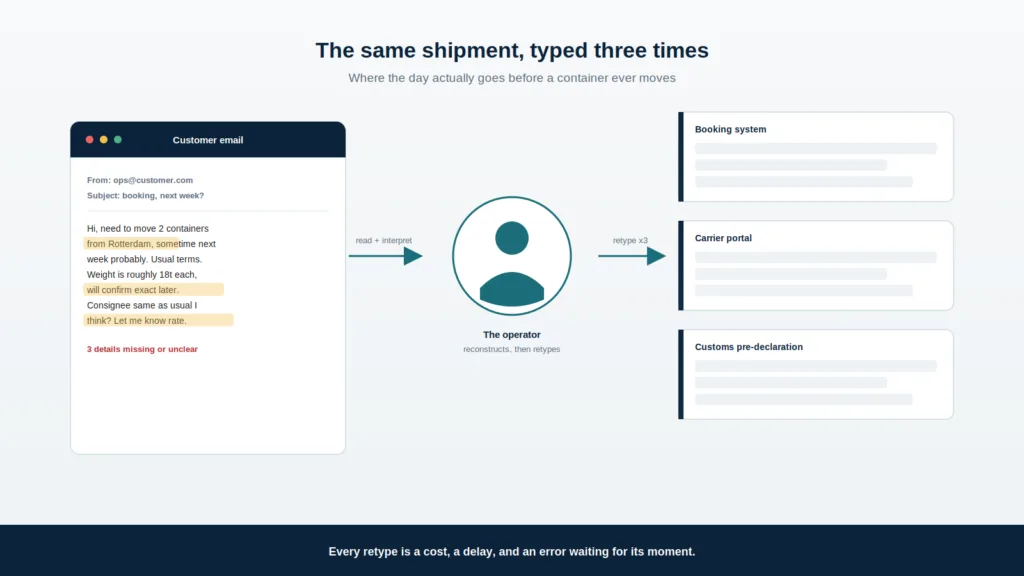
Walk into most forwarding offices around 9am. You’ll see two screens, an email open on one, the booking system on the other, and someone typing the exact same shipment details into both. The information came in as an email, or a PDF attachment, or a five-minute call, and somebody has to turn all that into usable data before anything downstream can touch it.
Nobody puts this on a process map. But for a lot of operators, it eats most of the day.
Ask a logistics executive what drives operational cost and you’ll hear about freight rates, demurrage, fuel surcharges, headcount. Ask the operator actually doing the work, though, and you get a different answer entirely: chasing customers for details they forgot the first time, keying the same booking into three different systems, checking a draft bill of lading against a packing list line by line, fixing something that was already wrong three weeks ago and only just surfaced at invoicing.
Both of them are right, weirdly. They’re just standing at opposite ends of the same problem.
And the cost is real. Probably bigger than most finance teams think, honestly, because it never sits in one line item where anyone can point at it. It’s spread thin across operator hours, expedite fees, credit notes, compliance rework, so it never actually reads as “manual data entry” on a report. What you see instead is margin leakage. A missed cut-off. A customer disputing an invoice for reasons that go back weeks. Different symptoms, one cause: the data going into the operation was never structured or checked before someone had to act on it.
Follow one shipment and you’ll see it everywhere
Take a shipment from first enquiry to final invoice and watch what happens at each stage.
The enquiry comes in as three or four lines, half the detail missing, and someone reconstructs a full requirement from memory and guesswork. By booking, that same information gets typed in again, sometimes for the third time, because it was already keyed once just to build a quote. Documentation is its own thing entirely, three documents, none of them individually wrong, they just don’t agree with each other, and somebody has to catch that manually. Compliance is worse, especially dangerous goods, where whatever got missed earlier becomes somebody’s problem now, on a deadline. Billing is where it all lands eventually: disputes over numbers that went wrong three weeks back, pieced together from email threads because nobody wrote down what actually changed and when.
None of this is a skills problem, to be clear. These are experienced people doing genuinely hard, judgement-heavy work. They’ve just become the connective tissue between systems that were never built to talk to each other, and there’s no name for that work anywhere, no line on any dashboard.
Want the full picture of what this costs your operation? See how Execution Readiness is measured and where most organisations are losing time.
More software hasn’t fixed it, and here’s why
It’s not like the industry is short on technology. Most operations run a TMS, an ERP, some kind of visibility platform, a couple of customer portals on top. Doesn’t matter. The problem’s still there because every one of those systems assumes the data reaching it is already correct. A TMS is genuinely excellent at rating and routing, once it has clean input. A visibility platform tells you exactly where a container sits, long after the shipment record behind it got pieced together by hand. Even RPA, which retypes information faster than any person could, has zero way of knowing whether what it’s retyping is actually right.
Every wave of logistics tech has sped up execution. Almost none of it touched whether the information going into execution was ready in the first place. That’s the specific gap Deep Current builds for, and it’s why these tools sit ahead of the TMS and ERP rather than trying to replace either.
Fixing it where the information first shows up
Ada handles demand as it arrives
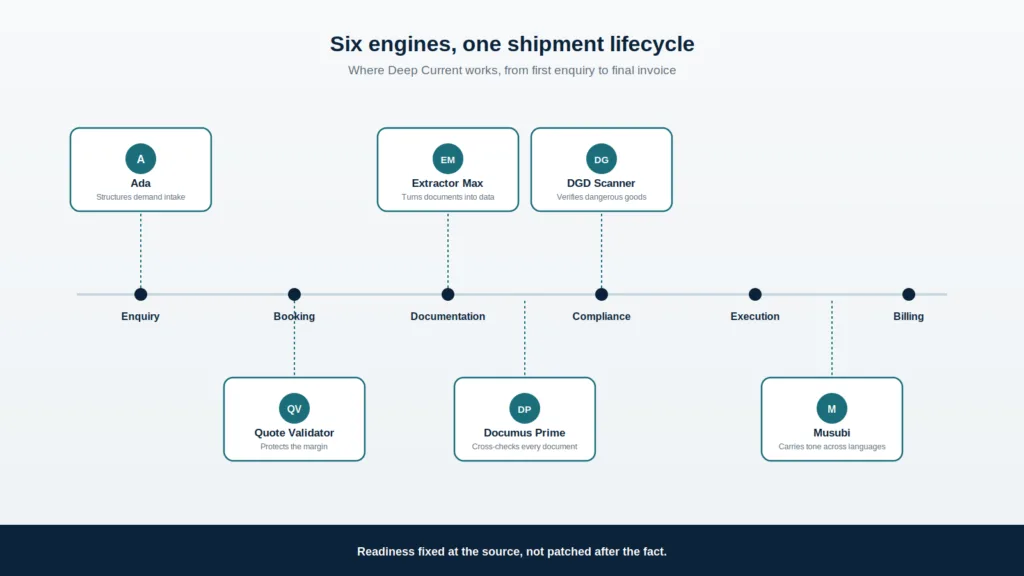
The cheapest way to avoid a retype is not needing one at all, and Ada reads enquiries and bookings the way an experienced operator would, in whatever language or format the customer happens to use, asking the clarifying questions before the file ever hits a desk. What lands is a complete shipment requirement. Not a paragraph someone has to decode at 8am.
Extractor Max turns documents into data
Booking confirmations, invoices, packing lists, carrier paperwork, most of it shows up in a format no system can act on. Extractor Max reads across structured and unstructured documents and converts everything into data your existing stack can use directly. A document someone has to read, versus a record that’s just already there.
Documus Prime catches what doesn’t match
The most useful check in any office is putting two documents side by side and spotting where they disagree. Documus Prime runs that comparison on every shipment, flagging discrepancies between bookings, drafts, and supporting paperwork before they turn into someone else’s problem three stages downstream.
DGD Scanner protects dangerous goods declarations
Not much costs more than an unverified detail here. DGD Scanner checks the physical declaration against booking and cargo data, catching what terminal inspection currently exists to catch, but earlier, before it becomes a hold nobody saw coming.
Quote Validator keeps the quote honest all the way to invoice
A quotation only matters if the number survives. Quote Validator checks quotes against live cost data and terms before they go out, and that’s usually where a fair chunk of margin quietly disappears without anyone noticing until reconciliation.
Musubi carries tone, not just words
Miscommunication is a data problem too, particularly where register matters as much as content does. Musubi handles English-to-Japanese business communication with the tonal control that generic translation tools tend to flatten out completely, so the relationship and the instruction both survive the trip.
What actually changes
Organisations that deal with this at the point information first enters tend to see the same shifts, more or less, whatever their size or trade lane. Chase cycles shorten because the shipment record is complete earlier. Fewer documentation holds, because discrepancies get caught before execution instead of during it. Compliance teams spend less time re-verifying everything and more time just confirming what’s already been checked. And the people who used to lose their mornings to retyping and cross-checking get that time back, for the parts of the job that actually need a person doing them.
There’s a second thing worth saying here, and it matters more than it looks. Any organisation exploring AI for quoting, booking, or documentation eventually runs into the same wall: automation is only as good as the data underneath it. Fixing readiness isn’t a side project sitting next to an AI roadmap. It’s what makes that roadmap actually survive contact with production instead of stalling out somewhere in the pilot.
Where to start
None of this means ripping out your existing stack. These tools sit alongside what you already run. Most organisations start wherever the pain is worst, usually the intake process generating the most chase cycles, or the document check that’s currently riding on one person’s attention more than anyone would like to admit out loud.
Want to see where your own operation is losing the most time? Book a readiness assessment and we’ll show you, using your actual shipment data, exactly where it’s happening and what fixing it is worth.
Frequently asked questions
Why do logistics companies still rely on manual data entry if they have modern systems? Because most systems, TMS included, visibility platforms too, are built to act on data that’s already correct. None of them structure or verify the unstructured stuff coming in by email, phone, or PDF. So that job still falls to a person.
How much does manual data entry actually cost a logistics operation? It almost never shows up as its own line item. It’s scattered across operator hours, chase-and-correct cycles, expedite fees, disputed invoices, compliance rework, which is exactly why most organisations have never put a single number on it.
Can AI safely handle logistics documentation without human review? Only once the data underneath it has been verified. AI running on unstructured, unchecked information doesn’t remove the errors, it just makes them happen faster. Structuring and validating the data first is what makes safe automation possible at all.
What’s the fastest place to start reducing manual data work? Intake, for most organisations. Structuring enquiries and bookings as they arrive tends to move the needle fastest, since that’s usually where the bulk of re-entry and chasing starts in the first place.