

Once you have spent enough time within the logistics ecosystem, talking to teams and stakeholders about day-to-day operations, you start noticing a pattern which is more often than not a common concern. If we were to sum up the discussions, they point to “we have the systems in place, so why does the work still feel so manual?”
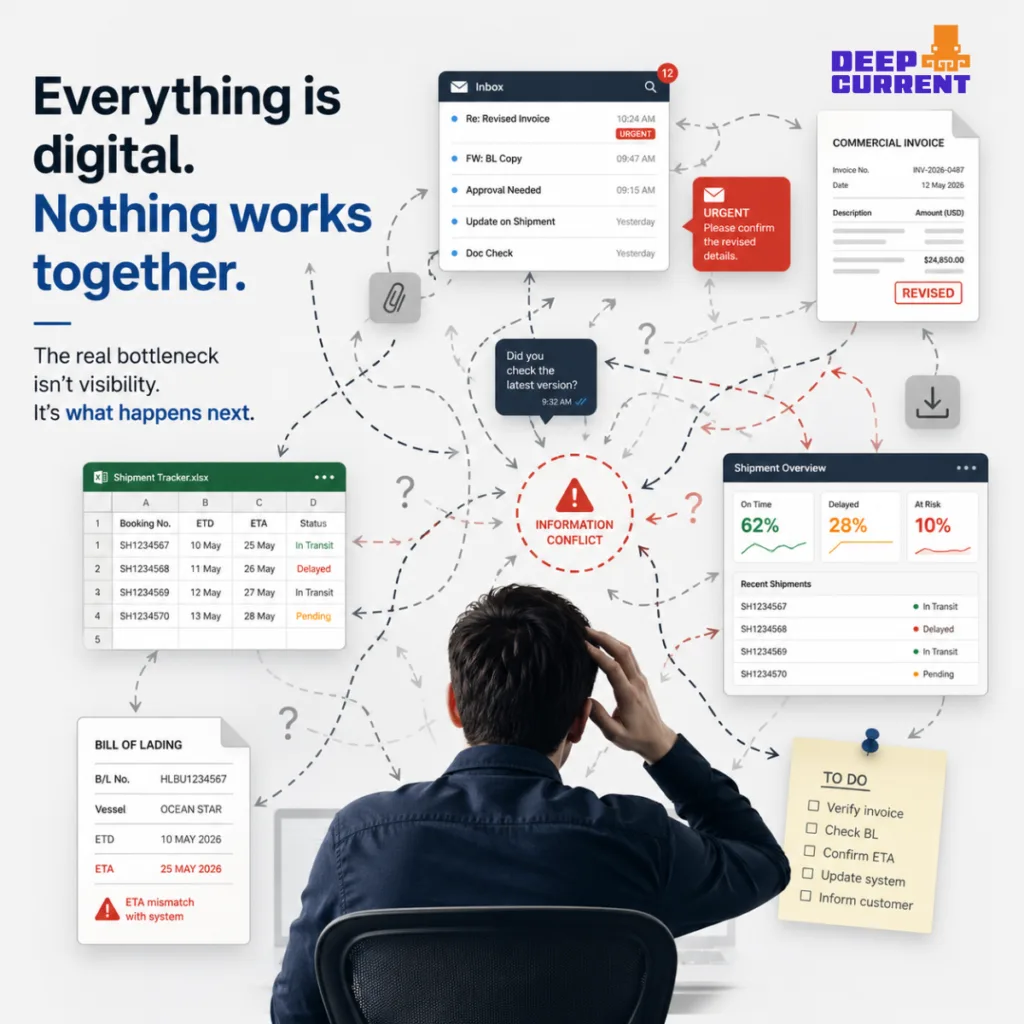
At Deep Current, we wanted to do a ground-level assessment on what actually is slowing down logistics in 2026 and while looking up various discussions with operators and stakeholders, a few lines kept surfacing:
- “Everything is there… just not in one place.”
- “I spend half my day chasing documents.”
- “The system says one thing, the email says another.”
- “We know it’s delayed. What we don’t know is what to do next.”
While if we look on paper, logistics in 2026 is fully digitised, governed by systems and processes with various dashboards and tracking mechanisms. But if we look closer, the real work actually happens elsewhere. The work mostly lives in emails, documents, spreadsheets and constant back-and-forth and most importantly, it lives in the effort that takes to connect all these together. This is the gap that seems to be missing in most transformation conversations.
The document problem that no one talks about
At first glance, documents don’t appear to cause any problems as they should be the simplest part of the workflow. They are created, shared and stored, it’s that simple! But in real world situations, they can slow everything down. Documents can not only go missing but there’s another major concern on trusting them.
We picked up this scenario – Upon arrival of a shipment, an invoice arrives, then a revised version follows. A bill of lading looks correct until someone cross-checks a detail. Now, a small inconsistency forces the team to pause and verify everything again. Over time, this creates a pattern where nothing moves forward until someone is completely sure. End result, the shipment is stuck. Now, the moment of hesitation by the team cannot be captured in any system but it affects the shipment.
We often see operations teams end up spending a disproportionate amount of time validating, rechecking, and confirming what should have been straightforward inputs. And until that confidence is established, decisions get delayed.
When email becomes the control tower
Despite the presence of multiple systems, email continues to be the backbone of logistics operations and rightly so. But, there’s always a catch when it comes to flooding of the inbox. When there are multiple emails coming in, approvals tend to sit buried within long chains of replies. Over time, email becomes the place where context lives. While all of this comes at a cost.Just a single thread can stretch across multiple stakeholders, each adding their own piece of information. Now, what should be a quick decision often turns into a search exercise.
Something we have seen in most bottleneck conversations, most teams are not just responding to information, they are in fact reconstructing it every time they open a conversation. That slows everything down in ways that are hard to measure but impossible to ignore.
The hidden cost of “just checking once more”
This is one pain point that we came across quite often. One of the most revealing patterns is how much manual effort still exists in supposedly digital workflows. The same data is often entered multiple times and it moves from email to system, from document to spreadsheet, and from one platform to another. Even after being entered, it is checked again, and then checked again.
This cannot be termed inefficient in the traditional sense, in fact, this is a response to a much deeper issue. When systems are not fully connected, and when inputs are not structured, people step in to bridge the gaps. They become the layer that ensures consistency, accuracy, and continuity. Over time, this creates a silent dependency. Operations rely not just on systems, but on the people who constantly validate and reconcile what those systems cannot.
The real bottleneck: decision uncertainty
During our assessment of various bottlenecks in 2026, one of the most critical slowdown factors that came up was not operational, it was decisional. Like in this case when a shipment is delayed, visibility is not a problem as teams can clearly see where the shipments are and what has gone wrong as well. The critical question or the main challenge is now what comes next. For instance, teams often stand at a decisive juncture:
- Should the shipment be rerouted?
- Is this delay critical or manageable?
- Is it worth escalating now or waiting for more clarity?
Nevertheless, these decisions are not inherently complex, but they do require complete, reliable, and contextual information. Hence, when documents are inconsistent, communication is fragmented, and data is scattered, decision-making becomes cautious. What this could mean is, teams wait for confirmation and they escalate more often than necessary or in some cases they act reactively under pressure. End result – over time, this slows down the entire operation.
Come 2026: everything works, just not together..yet!
If we take a step back, the issue actually becomes much clearer. The logistics industry in 2026 has not failed to digitise. In fact, the systems are already in place, data flows easily, processes and responsibilities are defined. But where the slowdown actually happens is that they do not connect in a way that reflects how work actually happens i.e. taking the realtime situations into account. The scenarios in the real world are not linear and are more often than not shaped by exceptions, no matter how much goes into planning scenarios. They depend on timely decisions and when these elements remain unstructured and disconnected, even the best systems fall short.
Looking ahead, the next phase of transformation is not about adding more tools for the sake of it. It is about rethinking what those tools are meant to do. Instead of focusing on tracking and reporting, the emphasis needs to shift toward enabling decisions. That means making information usable, not just available. It means reducing the effort required to interpret inputs, and it means bringing clarity to moments that currently rely on manual judgment. This is where we sense the opportunity lies.
Where Deep Current fits in
At Deep Current, the focus is on the layer where most of the real work happens.
DocuMus Prime (AI tool that handles all the paperwork – double-checks logistics documents so teams can work smoothly without the usual manual hassle) addresses the document challenge by going beyond extraction. It interprets, validates, and structures documents in a way that aligns with operational workflows. This reduces the need for repeated checks and helps teams move forward with confidence.
At the same time, Ada (Deep Current’s AI tool that handles the inbox and manages client queries in real time) works across communication flows, particularly email. It helps surface what matters, provides context, and supports faster, more informed responses. Instead of teams having to piece together information manually, they are guided toward the next best action.
Together, these capabilities help shift operations from being reactive and fragmented to structured and decision-ready.