

Freight-rate uncertainty, the return of Suez services, fleet expansion, geopolitical risks and changing trade flows are reshaping the maritime and logistics landscape. Here is what matters most in the months ahead.
The global shipping industry is approaching the end of 2026 with a market that is becoming increasingly difficult to read through traditional indicators alone.
Cargo demand remains resilient in several major markets, yet freight rates are showing signs of softening. Carriers are attempting to defend pricing through capacity management, while the gradual return of vessels to traditional shipping routes is changing the global capacity equation. Meanwhile, geopolitical uncertainty, port congestion and infrastructure constraints continue to influence the movement of goods.
Beyond container shipping, the wider maritime industry is also navigating a significant transition. New vessel deliveries, changing commodity trade flows, shipbuilding investment, energy security and shifting trade policies are creating different opportunities and risks across shipping segments.
The central question is no longer simply whether global trade will grow. It is whether the industry’s vessel capacity, infrastructure and operating networks can adapt to changing trade patterns without putting further pressure on commercial returns.
As we look towards December 2026 and the first quarter of 2027, ten developments deserve particular attention.
1. Container shipping: Healthy cargo volumes, but a more complicated rate environment
The container shipping market is showing increasingly divergent trends across its major East–West trade lanes.
On the Trans-Pacific, spot freight rates have been gradually declining following the earlier peak-season rally. Drewry’s World Container Index fell 3% to $4,176 per FEU on November 19. Shanghai–Los Angeles rates declined 5% to $7,026, while Shanghai–New York rates dropped 9% to $8,194.
The Asia–Europe picture is somewhat different. Rates have demonstrated greater resilience, with carriers attempting to introduce successive general rate increases in December.
However, announced rate increases and realised freight rates are two very different things. Whether carriers can successfully implement these increases will depend on demand, vessel utilisation, capacity withdrawals and the competitive environment.
An interesting contradiction is emerging in the US market. October container imports reached a record 2.675 million TEU, up 16% year-on-year, according to Descartes Datamyne. Yet Trans-Pacific spot rates have continued to decline.
This suggests that healthy cargo volumes do not automatically translate into stronger freight rates. The availability of vessel capacity, schedule reliability and competitive behaviour among carriers are equally important.
What to watch: Whether December rate increases hold beyond their announced implementation dates, and whether the divergence between cargo volumes and freight rates continues into early 2027.
2. The Suez return: A potentially significant capacity reset
One of the most consequential developments to watch is the gradual return of container services through the Suez Canal and the Red Sea.
The diversions around the Cape of Good Hope have significantly extended voyage times, tying up vessels and reducing the effective capacity available to the market. As services return to Suez, shorter sailing distances and faster vessel rotations could release capacity without requiring a single additional ship to enter service.
The transition is already underway. Ocean Network Express has resumed Suez transits, while other carriers are gradually restoring selected services on Asia–Europe routes.
This development has implications well beyond freight rates.
Faster vessel rotations could change vessel deployment, container repositioning requirements and equipment availability across Asia, Europe and the Mediterranean. At the same time, overlapping arrivals from vessels using different routes could create fresh pressure on ports and inland infrastructure.
The uncertainty is whether the security environment will allow a sustained return. Carriers must weigh the commercial benefits of shorter routes against the safety of vessels, crews and cargo.
What to watch: Actual service restorations, the number of vessels returning to the route, changes in sailing schedules and the resulting increase in effective capacity. Carrier announcements alone are not sufficient evidence of a sustained return.
3. Fleet expansion: The next capacity challenge is already taking shape
The shipping industry is approaching another significant fleet expansion cycle.
Shipowners have placed substantial newbuilding orders across container shipping, tankers and gas carriers. While deliveries will be spread across several years, the volume of tonnage scheduled to enter the market raises important questions about future supply-demand balances.
Danish Ship Finance’s November outlook highlights the scale of the global shipbuilding orderbook, which expanded from approximately 60 million compensated gross tonnes in 2020 to 210 million in September 2026.
For container shipping, scheduled additions during 2027–2029 are equivalent to almost 32% of the existing fleet, according to the report.
The timing is important. The ships being ordered today may enter service in a market with very different trading conditions from those that encouraged the original investment.
For container carriers, the combination of new deliveries and the return of Suez services could put pressure on capacity management and freight rates.
The picture is not identical across maritime segments. Dry bulk, tanker and gas carrier markets have different supply-demand dynamics, cargo requirements and vessel deployment patterns.
What to watch: Actual vessel deliveries versus scheduled orderbook additions, scrapping activity, fleet utilisation and whether demand growth can absorb the additional capacity.
4. Geopolitical risks: The cost of uncertainty remains embedded in shipping
Geopolitics continues to be one of the most influential variables in maritime operations.
The Red Sea crisis has already demonstrated how quickly a regional security event can change global shipping routes, extend transit times and alter vessel availability. The Strait of Hormuz remains another critical risk area because of its importance to global energy shipments.
Any escalation could affect shipping insurance, fuel costs, vessel deployment and cargo movements well beyond the immediate region.
The implications are not limited to container shipping. Tankers, LNG carriers, dry bulk vessels and project cargo operators are all exposed to different aspects of geopolitical disruption.
Meanwhile, trade policy is adding another layer of uncertainty. Businesses continue to adjust sourcing, inventory and routing decisions in response to changing tariff structures and restrictions.
For logistics providers, this creates a more complicated planning environment in which the cheapest route may not always be the most commercially viable or operationally reliable.
What to watch: Security developments in the Red Sea and Strait of Hormuz, war-risk insurance costs, carrier routing decisions, sanctions and changes in major trading relationships.
5. Port congestion and labour: More vessel capacity does not automatically mean smoother operations
While additional vessel capacity could ease pressure on freight rates, port congestion remains a significant constraint.
DHL Global Forwarding’s November market update estimates that congestion and weather-related disruption in Asia have tied up more than 10% of the global container fleet, equivalent to approximately 3.6 million TEU of capacity.
Although conditions are beginning to improve, the normalisation of vessel schedules and port operations could take several months.
Landside infrastructure, including terminals, trucking and inland connections, may continue to constrain the movement of cargo.
Labour uncertainty presents another immediate risk.
At the ports of Los Angeles and Long Beach, negotiations involving the Pacific Maritime Association and ILWU Local 26 watchmen have created uncertainty around operations. The November 21 contract deadline is an important event to assess in the final weeks of 2026.
The dispute is a reminder that port operations depend on a much wider network of workers and services than vessel and terminal capacity alone.
What to watch: Port dwell times, vessel waiting times, terminal productivity, labour negotiations and the speed at which congestion normalises.
6. Global trade flows: Demand is changing, not necessarily disappearing
The wider logistics market is experiencing a shift in the composition and geography of demand.
US import volumes remain strong, but businesses continue to adjust sourcing, inventory and routing decisions in response to changing trade policies and geopolitical conditions.
Technology infrastructure, semiconductors, electrification, renewable energy and large-scale industrial projects are also generating different logistics requirements from traditional consumer imports.
This matters because not all cargo growth creates the same demand for shipping capacity, equipment or logistics services.
For example, a rise in project cargo and energy infrastructure investment may create opportunities for specialised heavy-lift and breakbulk operators, even when traditional container freight markets are under pressure.
Similarly, shifts in sourcing between China, Southeast Asia, India and other manufacturing centres could change regional container positioning requirements and demand for feeder and inland logistics services.
The result is a more fragmented demand environment, with different regions and cargo categories experiencing different growth trajectories.
What to watch: Import and export volumes by origin and destination, sourcing shifts, industrial investment, inventory levels and sector-specific cargo demand.
7. Panama Canal: Routing flexibility remains an important competitive factor
The Panama Canal has gradually increased its operating capacity following the drought-related restrictions that affected transit volumes in previous years.
The Panama Canal Authority increased daily Neopanamax slots to ten from October 15, bringing combined daily availability across both lock systems to 33 slots.
This provides additional routing flexibility for container shipping, energy cargo and other maritime segments.
However, transit availability is not determined by slot numbers alone. Water levels, draft restrictions, reservation availability and vessel requirements continue to influence commercial decisions.
The canal remains particularly important for services connecting Asia with the US East Coast and Gulf Coast, as well as for certain energy and bulk commodity movements.
What to watch: Daily transit availability, draft restrictions, reservation costs and the canal’s ability to maintain stable operating conditions through changing weather patterns.
8. Container availability and repositioning: The equipment story deserves more attention
Much of the shipping market discussion focuses on vessel capacity and freight rates. But container availability is another important indicator of how efficiently the global shipping network is functioning.
Changes in vessel deployment, sailing schedules and trade-lane imbalances can influence where containers accumulate and where shortages emerge.
The gradual restoration of Suez services, for example, could change equipment circulation times between Asia and Europe. Changes in US import demand could also affect empty-container availability and repositioning requirements.
For container lessors, traders, depots and NVOCCs, these developments could create different commercial conditions across regions.
An increase in vessel capacity does not automatically mean that containers will be available in the right locations at the right time.
What to watch: Empty-container availability, leasing rates, depot inventories, equipment turnaround times and repositioning costs across Asia, Europe and North America.
9. Maritime investment and technology: The efficiency imperative is growing
The next phase of maritime competition will not be determined by fleet size alone.
Shipowners, carriers, ports and logistics providers are increasingly focused on improving operational efficiency, visibility and asset utilisation.
Digital platforms, predictive analytics, automation and AI-based planning tools are creating opportunities to improve vessel operations, cargo visibility, maintenance planning and equipment management.
At the same time, investment in alternative fuels, vessel efficiency and decarbonisation technologies is changing the economics of fleet investment.
However, the adoption of technology is uneven. The business case depends on the ability to integrate data across vessels, terminals, customers and logistics networks.
The companies that benefit most will not necessarily be those investing in the most technology, but those able to translate it into measurable operational improvements.
What to watch: Investments in port automation, fleet optimisation, maritime AI, alternative-fuel vessels, digital documentation and integrated logistics visibility.
10. Dry bulk and tanker markets: Different fundamentals, different risks
A broader maritime outlook must also look beyond container shipping.
Dry bulk markets are influenced by commodity demand, infrastructure investment, agricultural trade, energy requirements and changes in vessel supply.
Iron ore, coal, grain and other bulk commodity movements remain sensitive to industrial activity in China, infrastructure development and global trade patterns.
Tanker markets face a different set of forces, including oil production decisions, refinery demand, sanctions, fleet age and the movement of crude and refined products across longer distances.
For both segments, geopolitical disruptions can temporarily support vessel earnings by changing trading distances and vessel availability. However, the arrival of additional tonnage could put pressure on freight markets if demand does not keep pace.
What to watch: Commodity trade volumes, Chinese industrial demand, oil production and export patterns, tanker and dry bulk orderbooks, and changes in tonne-mile demand.
The industry watchlist: Where will the biggest impact come from?
Not every development deserves the same level of attention. Some could fundamentally alter shipping economics, while others are more likely to create temporary or trade-specific disruptions.
To make the outlook more useful for industry decision-makers, we have assessed ten developments according to their potential impact intensity and the likelihood of a material impact during the coming months.
How to read the assessment
- Impact intensity: Potential scale of the consequences for the maritime and logistics industry, rated from 1 to 5.
- Likelihood: Qualitative assessment of how likely a material impact is during the December 2026–March 2027 outlook period.
The scores are analytical assessments, not statistical forecasts.
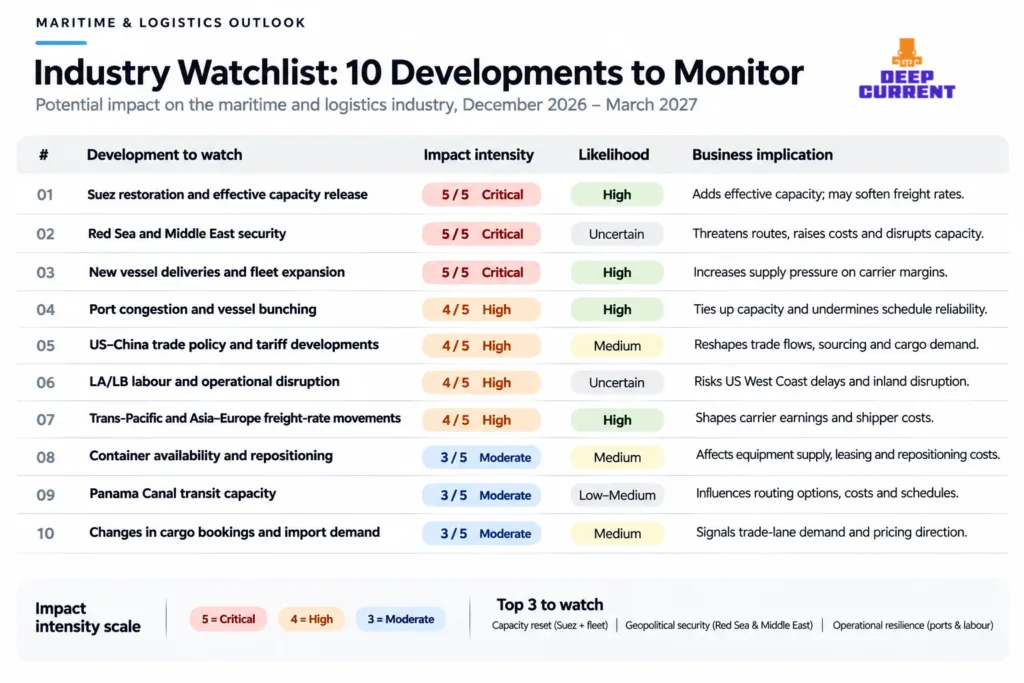
1. The capacity reset: Suez restoration meets fleet expansion
This is arguably the most important structural development for container shipping.
The return of services through Suez could release effective vessel capacity, while new ships entering the market add further supply. If cargo demand does not grow sufficiently to absorb this capacity, carriers may face increasing pressure on utilisation and freight rates.
2. Geopolitical uncertainty: A disruption can reverse the market’s direction
The security situation in the Red Sea and Middle East remains difficult to predict. A renewed escalation could reverse routing decisions, extend transit times and tighten effective capacity again.
This is why a high-impact development should not be dismissed simply because its likelihood is uncertain.
3. Operational resilience: The bottleneck may move from vessels to infrastructure
Even as more vessel capacity becomes available, port congestion, labour constraints and inland infrastructure limitations can continue to restrict the movement of cargo.
The industry’s ability to absorb additional capacity will depend partly on whether ports and logistics networks can operate efficiently.
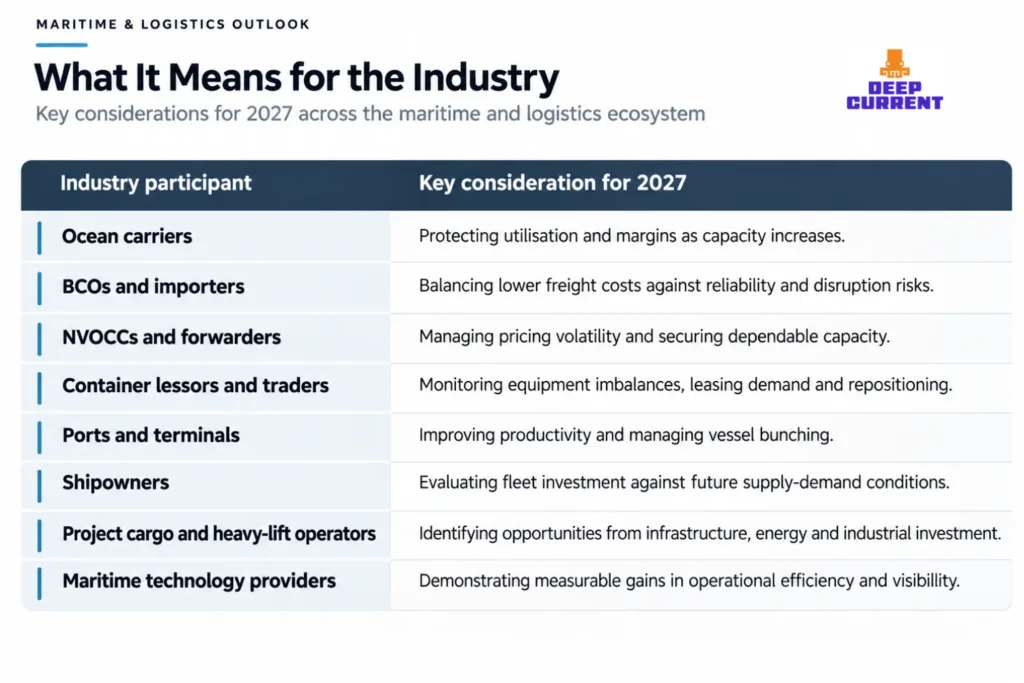
What does this mean for different industry participants?
The same market development can create very different consequences for different participants.
Looking ahead: The next shipping cycle will reward operational intelligence
The global shipping and logistics industry is not moving in one clear direction.
Container freight rates are facing pressure on some major routes, while carriers are attempting to defend pricing elsewhere. Suez restoration could release additional capacity, but port congestion and geopolitical uncertainty continue to complicate the picture. New vessel deliveries will shape the longer-term supply outlook, while changing trade flows and infrastructure investment are creating different demand patterns across the maritime ecosystem.
The next few months will therefore be less about identifying one dominant market trend and more about understanding how several forces interact.
For carriers, this means managing capacity and protecting network economics. For shippers, it means balancing freight costs against service reliability and supply-chain exposure. For NVOCCs, forwarders and logistics providers, it means anticipating shifts in capacity, equipment availability and customer requirements.
For the wider maritime industry, operational efficiency, infrastructure readiness and the ability to respond to uncertainty will become increasingly important.
The bigger question for 2027 is whether the industry’s capacity, infrastructure and operating networks can adapt to a market where trade flows remain active, but the economics of moving cargo are changing.
The companies that understand these changes early will be better positioned to make decisions on capacity, routing, equipment, investment and customer commitments.