

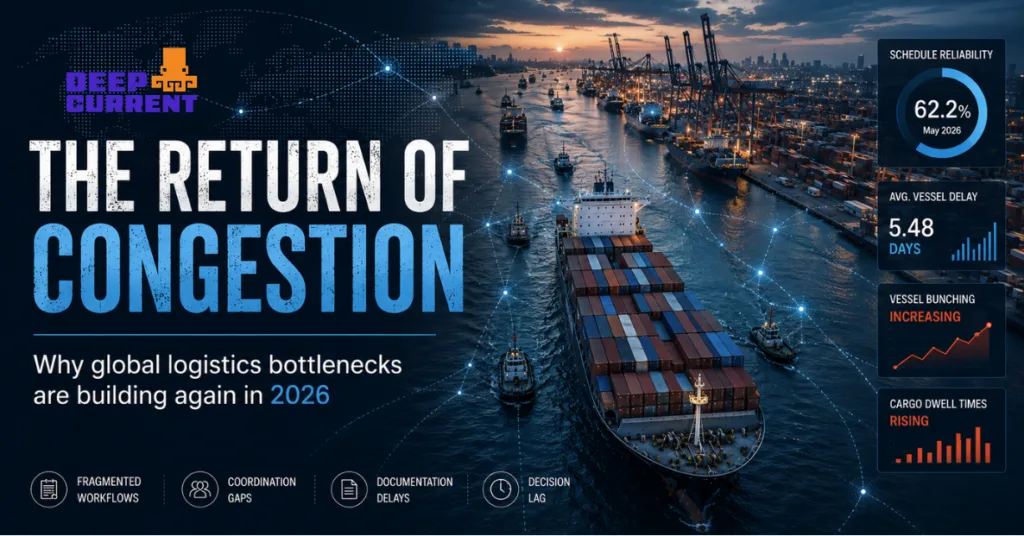
Global logistics networks are facing rising delays, vessel bunching, and operational pressure again in 2026. But unlike previous cycles, the challenge now extends far beyond port capacity alone. Coordination gaps, fragmented workflows, and operational decision-making are increasingly shaping how congestion develops across supply chains.
At the beginning of 2026, many across the logistics industry believed the worst of global congestion was finally behind us.
Ports had expanded capacity. Visibility tools had improved. Carriers and logistics providers had spent years redesigning networks, strengthening operational resilience, and refining planning cycles after repeated disruption periods.
For a brief period, stability appeared to be returning.
Yet only months later, congestion is quietly re-emerging across major trade corridors.
Schedule reliability remains under pressure. Vessel bunching patterns are resurfacing. Cargo dwell times are rising again. Operational volatility continues to ripple through shipping networks already dealing with geopolitical uncertainty, rerouted trade flows, and fluctuating demand patterns.
The current congestion cycle also reflects a broader operational shift taking place across global logistics. Increasingly, delays are developing through coordination pressure across systems, stakeholders, documentation flows, and operational decisions surrounding cargo movement.
Operational imbalance through the networks
Traditionally, congestion was viewed through a relatively straightforward lens: Too much cargo entering a system with insufficient physical capacity naturally created delays.
In response, ports and terminals across regions accelerated:
- infrastructure expansion
- automation programs
- digitalisation initiatives
- visibility investments
- operational optimisation projects
Many of these investments improved resilience significantly. However, congestion signals are now beginning to return despite those improvements.
Physical infrastructure remains critical, but operational synchronisation across the broader logistics ecosystem is becoming equally important.
Across global supply chains, even relatively manageable cargo volumes are creating operational instability because arrival patterns have become increasingly unpredictable.
Ports are now frequently managing:
- concentrated waves of vessel arrivals
- compressed discharge windows
- fluctuating yard utilisation
- inconsistent inland transport coordination
- rapidly shifting carrier schedules
This creates operational imbalance throughout the network.
Schedule reliability still hasn’t recovered
Recent industry data continues to highlight how fragile operational stability remains across container shipping.
According to May 2026 schedule reliability data published by Sea-Intelligence and Drewry, global schedule reliability remains around 62.2% — still well below the historical pre-crisis benchmark of roughly 70–80%.
At the same time:
- average vessel delays continue to hover around 5.48 days
- reliability gaps between carriers remain substantial
- schedule predictability continues to vary significantly across trade corridors
For shippers and logistics operators, this creates a planning environment where operational certainty remains difficult to maintain.
Even relatively manageable delays can quickly compound across:
- berth planning
- yard allocation
- labour scheduling
- trucking coordination
- customs readiness
- inventory management
And when disruptions trigger sudden carrier network adjustments, operational planning cycles compress even further while coordination requirements intensify simultaneously.
This is where congestion begins to compound across the broader ecosystem.
Congestion in 2026 feels different
One of the biggest shifts in 2026 is that congestion increasingly develops through operational variability rather than purely through visible physical limitations.
In earlier disruption cycles, the constraints were often more direct:
- too many ships
- limited terminal space
- insufficient equipment
- overwhelmed infrastructure
Today, many operational pressures begin much earlier in the workflow.
The pressure increasingly stems from:
- fragmented communication
- disconnected systems
- inconsistent operational data
- delayed approvals
- reactive coordination
- misaligned workflows across stakeholders
In many situations, ports become the visible bottleneck only after operational friction has already accumulated upstream.
As logistics environments become more interconnected and volatile, congestion is increasingly shaped by how effectively cargo flow, operational decisions, and stakeholder coordination remain aligned under pressure.
The growing cost of operational unpredictability
One of the clearest operational challenges across modern logistics is no longer simply volume — it is unpredictability.
Even relatively stable cargo flows can create disruption when operational timing becomes inconsistent.
For example:
- vessels arrive outside planned windows
- documentation readiness varies by shipment
- inland transport schedules shift rapidly
- exceptions emerge faster than teams can process them
As variability increases, organisations are forced into increasingly reactive operational behaviour.
This creates:
- repeated replanning
- manual intervention
- duplicated communication
- operational firefighting
- slower decision cycles
The cumulative impact is significant.
Because logistics networks operate as interconnected systems, even relatively small coordination delays can quickly cascade across multiple stakeholders and workflows.
Why visibility alone no longer enough
Over the last several years, the logistics industry has invested heavily in visibility infrastructure.
Control towers, predictive ETAs, real-time tracking platforms, monitoring systems, and operational dashboards have substantially improved situational awareness across supply chains.
However, operational response and decision execution have not always advanced at the same pace.
Knowing that a shipment is delayed is useful.
Knowing what operational adjustment should happen next is far more valuable.
This is becoming one of the industry’s largest operational gaps.
According to recent Gartner supply chain insights, organisations are increasingly struggling not with data availability, but with the speed and quality of operational decision-making.
As operational complexity rises, the gap between visibility and coordinated action becomes increasingly expensive.
The hidden role of documentation and communication delays
One of the least visible — but most persistent — contributors to congestion remains operational friction surrounding documentation and communication workflows.
A shipment may be physically ready to move.
Yet operations still stall when:
- approvals remain pending
- documents contain inconsistencies
- operational updates arrive through fragmented channels
- stakeholders work from conflicting information
- teams spend time reconciling data instead of executing decisions
Despite broader digitalisation efforts, documentation inefficiencies continue to create substantial operational drag across logistics networks.
Industry discussions across 2025–2026 increasingly point toward paperwork-related friction as a meaningful contributor to shipment delays, particularly in environments where operational coordination still depends heavily on manual communication and disconnected systems.
Large volumes of operational information already exist across logistics workflows, though much of it still moves through fragmented channels and inconsistent processes.
When information flow slows down, operational flow tends to follow closely behind.
Why logistics is moving toward flow orchestration
The next phase of logistics efficiency will likely depend on something broader than infrastructure investment alone.
It will increasingly depend on how effectively organisations orchestrate flow across:
- systems
- stakeholders
- communication
- documentation
- operational decisions
The organisations responding most effectively to congestion today are focusing on:
- faster exception resolution
- tighter stakeholder coordination
- cleaner operational data flow
- reduced manual intervention
- stronger integration between structured and unstructured information
- faster operational decision-making under uncertainty
This reflects a meaningful shift in operational thinking.
Competitive advantage increasingly depends on how quickly organisations can respond when operational complexity rises.
Where this shift becomes operational
This is the operational layer Deep Current focuses on.
Because congestion rarely develops through one isolated operational failure.
More often, it emerges through:
- delays in communication
- fragmented information
- document inconsistencies
- disconnected workflows
- slow operational decision cycles
Deep Current’s operational intelligence layer is designed to reduce friction before it compounds downstream.
- Ada structures inbound operational communication and helps standardise incomplete or fragmented shipment requests before execution begins.
- Documus Prime validates logistics documentation and identifies inconsistencies before they develop into operational bottlenecks.
- Extractor Max reduces duplicate data handling across disconnected systems and workflows.
Together, these capabilities support cleaner operational coordination across logistics environments before disruption escalates into physical congestion.
As supply chains continue operating under growing volatility and interconnectedness, logistics performance will increasingly depend on how efficiently information, decisions, and operational coordination move alongside cargo itself.
Conclusion
Ports may remain the most visible bottlenecks in global trade.
Yet many of the deeper operational constraints now develop long before cargo physically stops moving.
In 2026, congestion increasingly reflects the speed, clarity, and alignment of operational decision-making surrounding cargo movement.
As global logistics networks continue operating under rising complexity, the organisations that perform best will likely be the ones capable of maintaining operational flow even when unpredictability increases across the ecosystem.