
Planning is a critical element of the logistics industry and one statement that almost everyone associated with the industry would have heard quite often is: “We’ve accounted for the delay.” A statement which has been used and abused in most of the review meetings, customer calls, internal updates and so on.
While this does hold true (up to a certain point) when we could clearly see a shipment being delayed, for which the reason is known and the impact is also somewhat estimated and on paper, everything is under control. But is it? If you spend time with the operations team handling the same shipment, more often than not, the story sounds very different. This is because the delay itself is only a small part of the problem but what follows is where the real cost concern begins.
What an exception actually looks like on the ground
Let’s try to break this down through an actual scenario. A container gets held up at the port and the reasons could be multiple – maybe due to congestion or route disruption like we are seeing nowadays due to the Middle-East conflict, could also be documentation linked, or a last-minute regulatory check – you get the point basically.
Reason isn’t that important because what happens next is predictable. An email goes out, then another, someone does documentation checks again, another team is looped in, the customer keeps asking for updates and the matter gets escalated internally.
The chain reaction no one measures: Now, despite all the planning an exception takes place and it triggers a chain reaction. Not just operationally, but across people, systems, and decisions because someone has to figure out what exactly went wrong. Someone has to validate whether the information is accurate and someone has to decide whether to wait, reroute, escalate, or absorb the delay.
And rarely does all of this happen in one place because all areas are flagged – emails, documents, system and conversations. Each step introduces friction and it keeps adding up. By the time a decision is made, hours, sometimes days, have already passed and yet, none of this is formally tracked.
The invisible cost sitting inside every delay and why its getting worse in 2026
As we discussed at the beginning, planning is something the logistics industry does cover well in advance and they’re good at measuring outcomes. The usual KPIs including on-time performance, transit delays, cost per shipment are all well tracked but there is another layer of cost that sits beneath all of this.
The cost of:
- figuring out what is happening
- aligning stakeholders
- validating inputs
- deciding what to do next
All of this is not a single number and easily quantifiable to the eye but it shows up in various factors once we dig deep and identify collectively how much time was lost in coordination, the effort spent on rework, repeated checks and confirmations and on decision cycles that stretch longer than they should.
For 2026, exceptions are nothing new but what’s changed is their frequency, complexity, and impact. Over the past year, supply chains have been operating in a state of continuous adjustment:
- Geopolitical tensions have altered shipping routes.
- Security concerns have forced carriers to rethink transit paths.
- Port congestion patterns have shifted.
- Regulatory environments continue to evolve.
In such an environment, exceptions are no longer occasional disruptions, they could be seen as a constant. Almost every exception brings with it the same set of questions:
- What is the real situation?
- What are our options?
- What should we do now?
When this happens at scale, across hundreds or thousands of shipments, the hidden cost compounds quite quickly.
The real bottleneck is the decision
While most organisations today have much visibility, they know where shipments are and
the moment when something is off track. But visibility alone does not resolve an exception and what matters is how quickly and effectively a decision is made.
Now to make a logical and effective decision, if we take a step back, the critical feeders for decision making are reliable information, clear context and aligned stakeholders. In any of the scenarios if any of these are missing, the process slows down. As a result, teams either wait for additional data or they make reactive decisions under pressure. Over time, this becomes the real constraint on performance.
Why this cost remains invisible is because the problem does not sit neatly within a system. It lives in the gaps between systems.
The shift the industry needs to make
If the last decade was about building visibility, the next phase is about improving decision speed. This requires a different focus and not just on tracking what is happening but on enabling what should happen next.
To break this down into actionable steps, it means:
- Reducing the time it takes to understand a situation
- Improving the quality of inputs feeding decisions
- Aligning stakeholders faster
- Providing clarity in moments of uncertainty
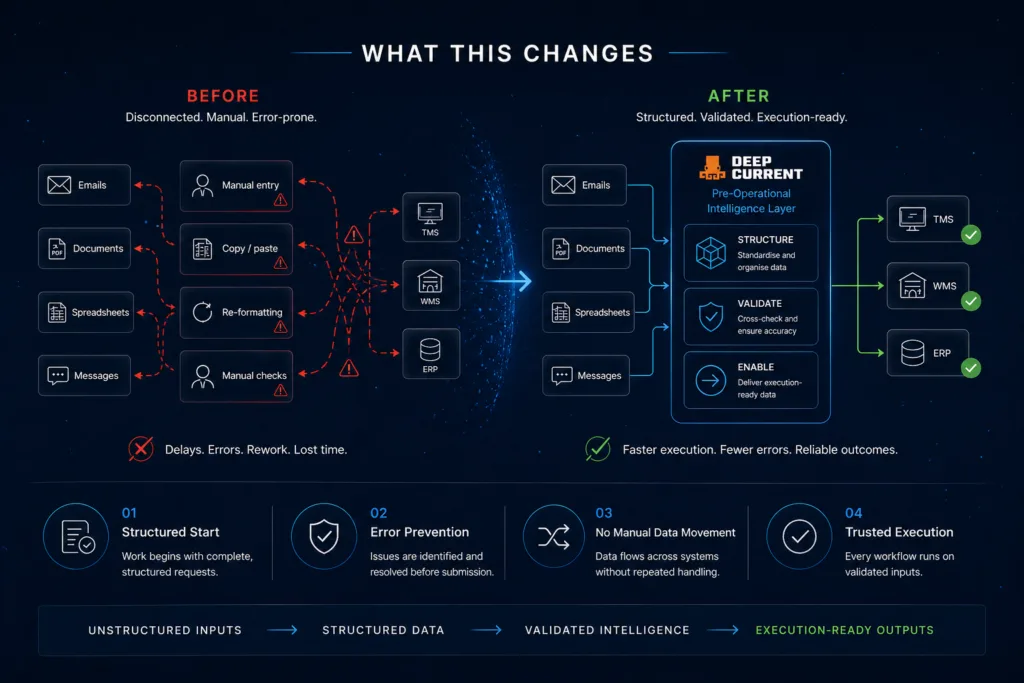
In other words, reducing the cost of handling exceptions. This is the layer Deep Current products are built for. Because the challenge is not just about data, it is about making that data usable in the moments that matter.
For instance, DocuMus Prime (AI tool that handles all the paperwork – double-checks logistics documents so teams can work smoothly without the usual manual hassle) helps ensure that documents, often the starting point of many exceptions, are accurate, validated, and aligned with operational context. This reduces the need for repeated checks and eliminates one of the biggest sources of delay.
At the same time, Ada (Deep Current’s AI tool that handles the inbox and manages client queries in real time) works across communication flows, especially email, where most exception handling actually takes place. It helps surface relevant information, bring context together, and guide teams toward faster, more informed decisions.
In 2026, considering how dynamic the work geopolitical order has become, the old ways of working can no longer be sustainable. Because, as supply chains become more complex, the cost of handling exceptions will only grow. The companies that move ahead will not just be the ones that reduce delays, they will be the ones that reduce the time and effort it takes to decide what to do about them.