

Automation is supposed to make the logistics operations faster and seamless. At least, that’s how it’s usually presented and pitched. But if you spend time with actual operations teams, the picture is very different.
Most of them are still running critical workflows on email, Excel, and a lot of manual checking. Not because they don’t have access to tools but because they don’t fully trust them. And to be fair, in many cases, that hesitation isn’t irrational.
It comes from experience.We sat down with a bunch of freight professionals to find out where the real struggles are, as we progress towards building custom-tools for logistics professionals to solve the broken workflows problems.
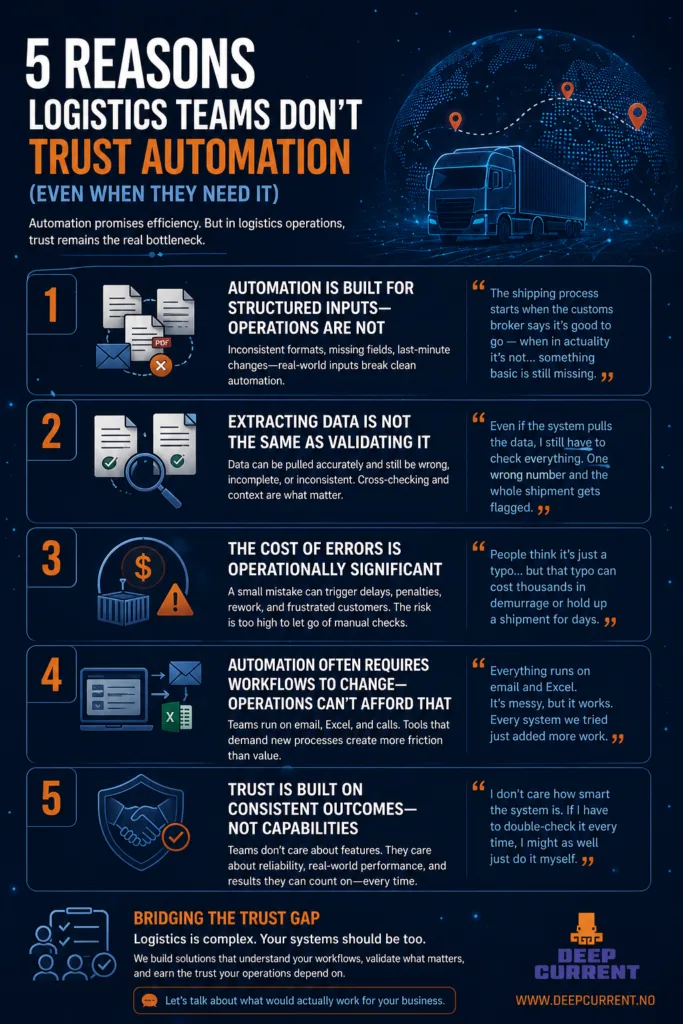
1. It works well until things get slightly messy
On paper, most automation tools look solid. Clean inputs go in, clean outputs come out.
But logistics rarely gives you clean inputs. Documents come in half-filled, formats change depending on the shipper, and someone almost always sends a “final version” that isn’t actually final.
“The shipping process starts when the broker says it’s good to go… but half the time something basic is still missing and you only find out when it’s already stuck.”
That’s where the problem starts.
Because the system doesn’t really break in a dramatic way, it just stops being reliable. And once that happens, people stop depending on it.
What actually helps here isn’t more automation, it’s better input control.
Systems that can catch missing or incomplete information before anything moves forward tend to earn more trust over time. That’s the logic behind tools like Ada, which focus less on processing and more on making sure the process starts correctly in the first place.
Ada is a smart chatbot built for sales teams working in logistics, answering emails from clients instantly and helping them get the details they need for delivery orders.
2. Pulling data out has improved, but validation is still the bottleneck
A lot of tools today are good at extracting data from documents. That part has improved a lot. But that’s not where most of the real work is. The real work is in checking whether that data actually makes sense:
- Does it match across documents?
- Is something missing that will matter later?
- Are we even looking at the latest version?
“Even if the system pulls everything perfectly, I still have to go through it. You miss one thing and it becomes a problem later.”
This is why automation often ends up sitting next to manual work instead of replacing it.
Because extraction alone doesn’t reduce risk.
What starts to change things is when systems move into cross-checking and validation, not just reading. Tools like Documus Prime are built more around that layer, looking at relationships between documents, not just fields inside them.
3. The downside of getting it wrong is too high
In some industries, if automation makes a mistake, it’s inconvenient.
In logistics, it’s expensive.
A small error can:
- Delay a shipment
- Trigger additional charges
- Create a chain of rework across teams
“People outside think it’s just a small mistake. But that one mistake can cost days and a lot of money.”
So teams compensate. They double-check. They keep backups. They don’t fully let go of manual control. From the outside, that looks like inefficiency. From the inside, it’s risk management. For automation to actually replace that behavior, it has to prove, not claim, that it reduces risk. Especially around documentation and consistency.
4. Most tools expect people to change how they work
This is probably the most underestimated issue. Real workflows in logistics are messy, but they’ve evolved that way for a reason. Things happen over:
- Email threads
- Excel sheets
- Calls
- Messages
It’s not pretty, but it’s flexible. Then a new system comes in and says: “Enter everything here, follow this flow, and don’t deviate.” That’s where friction builds.
“Everything we do is on email and Excel. Every system we tried just added more steps.”
So people revert. Not because they love manual work, but because they trust what they understand. The tools that tend to stick are the ones that work with existing behavior, not against it. For example, extracting structured data from emails and documents (instead of asking teams to stop using them) reduces effort without forcing a workflow shift, something Extractor Max is designed around.
5. If it needs checking, it’s not really saving time
At the end of the day, the decision is simple for operators.
“If I still have to check everything, what exactly is this saving me?”
That’s the bar. Not features. Not speed on paper. Just this:
- Does it work reliably?
- Can I trust the output without second-guessing it?
If the answer is no, even occasionally, people build workarounds. And once that happens, the system becomes optional.
Where the real problem sits
It’s easy to say logistics is slow to adopt automation. But that misses the point. The issue isn’t adoption, it’s alignment.
Most systems:
- Assume structured inputs
- Struggle with variability
- Don’t fully handle exceptions
- And require behavior change
Operations, on the other hand:
- Are input-heavy and inconsistent
- Run on exceptions
- Depend on context
- And evolve continuously
That gap is where trust breaks.
It’s not that teams don’t want automation.They just don’t trust it enough to rely on it.
Until systems align with how logistics actually runs, manual processes will continue to carry the load. They endure because they work when conditions aren’t ideal.
What most teams are dealing with isn’t a lack of tools, but a lack of systems that fit their day-to-day reality.
And as long as that mismatch exists, the responsibility stays with people, connecting the gaps, correcting the data, and keeping operations moving.
If that sounds familiar, it’s not a tooling problem. It’s a workflow problem.
And it’s solvable when the solution is built around your reality, not an ideal version of it.
Worth a conversation! Contact us at info@deepcurrent.no